· AI Automation · 15 min read
The Voice-to-Copy Method: How to Turn Your WhatsApp Audio Messages into Sales Emails Using AI
Learn how to clone tone of voice with AI for copywriting. Transform raw expert audio into high-converting sales assets using the Voice-to-Copy Engine. Start now!
Key Strategic Takeaways
- Structured foundation over transient prompts: Maintain repeatable positioning and audience context for voice-to-copy-method-ai-transcription.
- Brand continuity across assets: Use verified voice and offer information to reduce revision cycles.
- Measurable operational efficiency: Align drafting workflows with persistent brand memory to support consistent execution.
The single greatest bottleneck in the digital infoproduct economy isn’t a lack of knowledge—it’s the friction of translation.
High-tier mentors, course creators, and workshop experts possess immense, highly specialized domain expertise.
Yet, the moment they sit down in front of a blank document to write an email sequence, a newsletter, or an ad script, a cognitive shift occurs.
The natural, authoritative voice that commands rooms and closes high-ticket sales vanishes.
It is replaced by a stiff, formal, or hyper-generic corporate tone that completely alienates sophisticated buyers.
The digital marketing landscape across the United States has rejected this artificial, over-polished content style.
Top-converting funnels in 2026 rely on a framework known as the Voice-to-Copy Pipeline.
┌───────────────────────────────────────────────────────────────────────────────────────┐
|                            THE COGNITIVE TRANSLATION FILTER                           |
|                                                                                       |
|   [ TRADITIONAL WRITING ] ──> Blank Screen ──> Internal Filter ──> Stiff, Generic Copy|
|                                                                                       |
|                                         │                                             |
|                                         ▼                                             |
|                                                                                       |
|   [ VOICE-TO-COPY ENGINE ] ──> Raw Audio ──> AI Transcription ──> High-EQ Processing   |
|                                                                (Preserves DNA & Tone) |
└───────────────────────────────────────────────────────────────────────────────────────┘
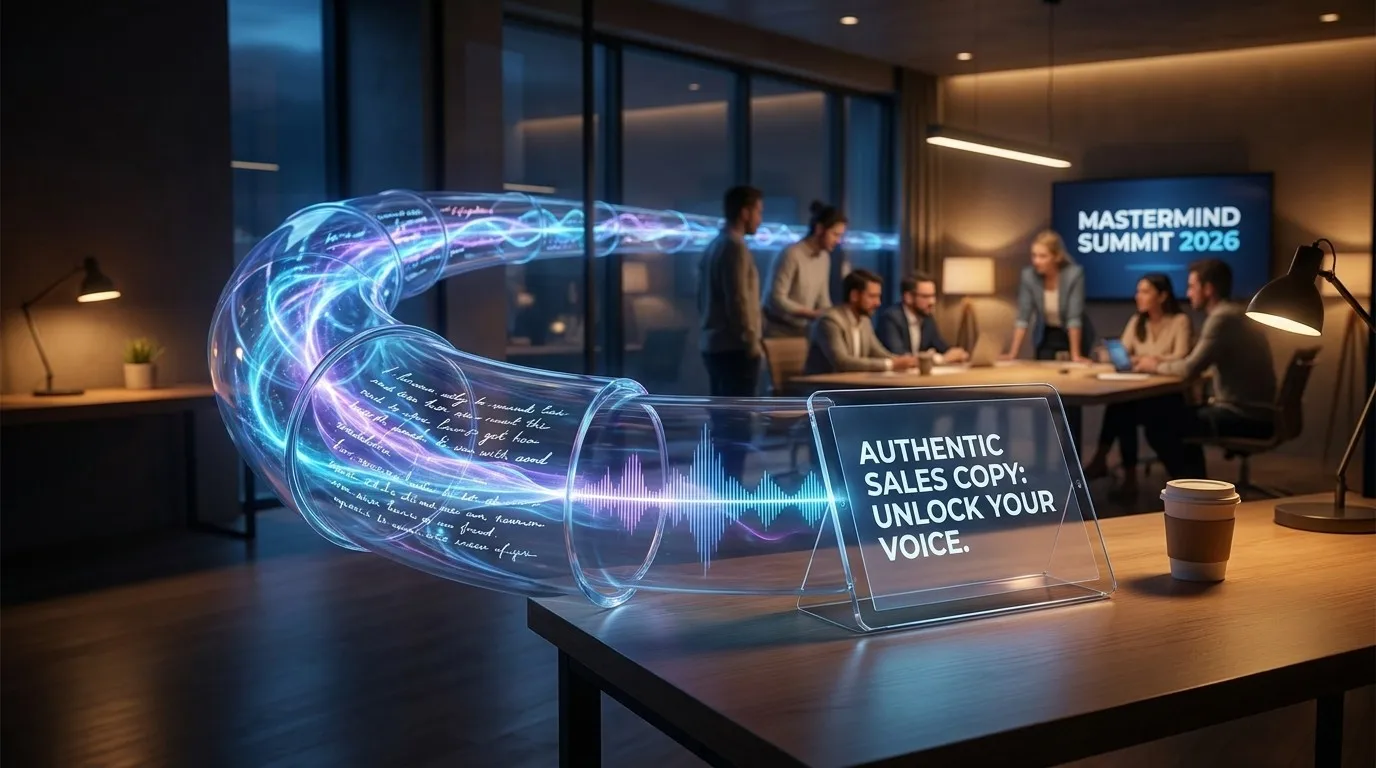
The concept is simple: your best marketing copy shouldn’t be written from scratch—it should be captured.
By recording unedited voice notes, transcribing the raw data, and using specialized LLMs with high Emotional Quotient (EQ) profiles, you can scale a highly authentic content pipeline.
This allows you to retain your exact speech cadences, industry insights, and unique personality markers.
This technical manual breaks down the operational pipeline of the Voice-to-Copy Engine, maps out the underlying behavioral psychology, and provides the production-ready code and engineering prompts required to automate this framework in your business.
A Mentor’s Greatest Asset: Irreplicable Authenticity
In a world flooded with boring copy, your authentic voice is the only competitive advantage that cannot be cloned by a competitor—unless they use your Brand DNA.
Authenticity is the bridge between a cold lead and a loyal student.
When you speak, you use micro-narratives and emotional anchors that a standard AI marketing avatar often misses.
The goal of Brand Intelligence is to capture these anchors before they are filtered by the act of writing.
1. The Operational Architecture of the Voice-to-Copy Pipeline
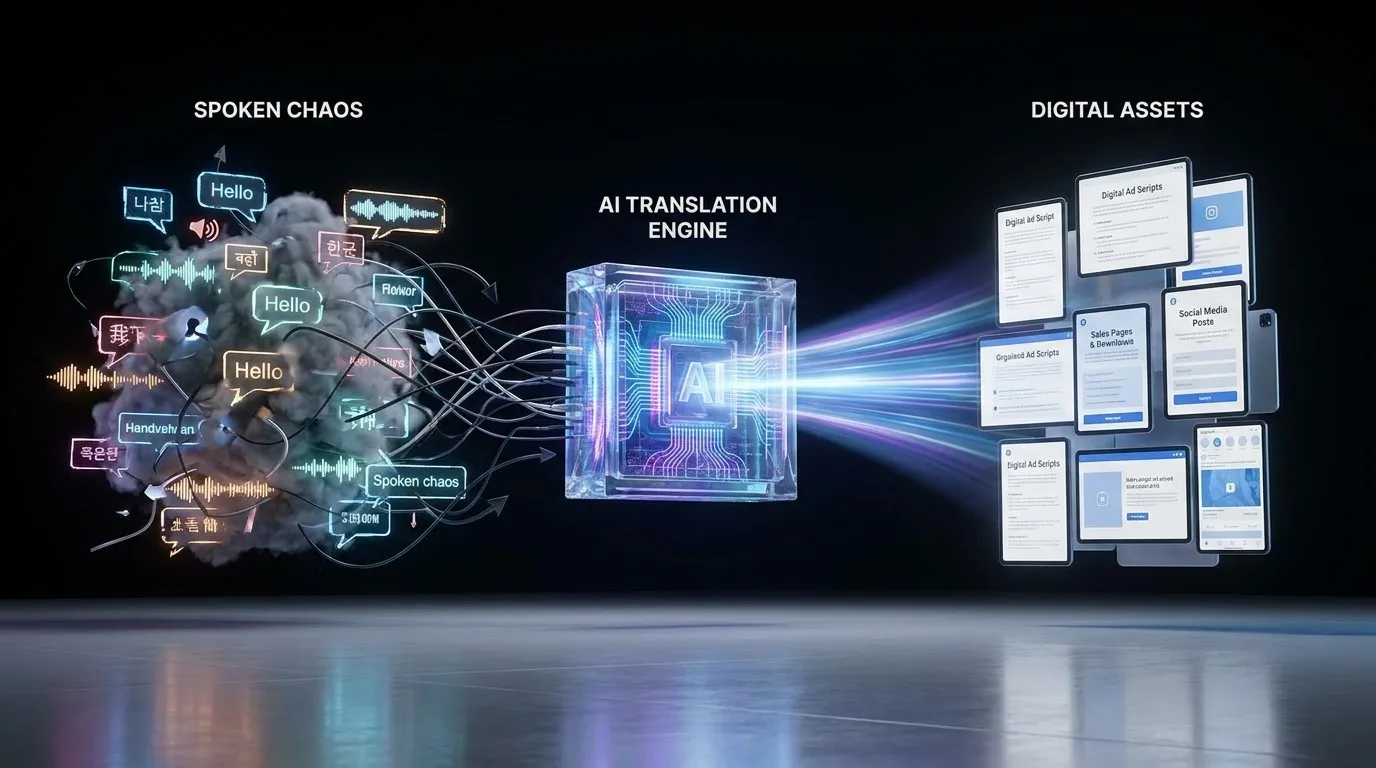
Operating a scalable Voice-to-Copy engine requires a structured, multi-step pipeline.
You cannot simply upload an audio file to a standard chat interface and expect high-converting copy.
The system must process the audio through distinct stages to clean up the formatting while protecting your authentic tone.
The diagram below details the operational workflow from initial audio capture to final, multi-platform publishing.
+---------------------------------------------------------------------------------------+
|                       THE 5-STAGE VOICE-TO-COPY PIPELINE ARCHITECTURE                 |
+---------------------------------------------------------------------------------------+
|  STAGE 1: ASYMMETRIC INPUT CAPTURE                                                   |
|  -> The expert records an unedited, 5-to-10 minute voice note detailing a system.     |
+---------------------------------------------------------------------------------------+
|  STAGE 2: SEMANTIC TRANSCRIPTION ENGINE                                               |
|  -> Raw audio is processed via Whisper/Deepgram APIs to export an unedited transcript.|
+---------------------------------------------------------------------------------------+
|  STAGE 3: BRAND VOICE DNA CALIBRATION                                                 |
|  -> The raw text is cross-referenced with your established Brand Voice Profile.       |
+---------------------------------------------------------------------------------------+
|  STAGE 4: HIGH-EQ MODEL EXTRACTION (CLAUDE)                                           |
|  -> The processing core strips out verbal filler while hardening core arguments.       |
+---------------------------------------------------------------------------------------+
|  STAGE 5: MULTI-CHANNEL ASSET DEPLOYMENT                                               |
|  -> The finalized asset is automatically formatted for Newsletters, Ads, or Sales Pages|
+---------------------------------------------------------------------------------------+
Stage 1: Asymmetric Input Capture
The expert records a casual, unedited 5-to-10 minute voice memo.
There is no script, no formal structure, and no editing.
The expert simply records their thoughts while driving, walking, or answering a student’s question on WhatsApp or Slack.
This raw format is highly valuable because it contains natural analogies, spontaneous pacing, and industry jargon that rarely survive a formal writing process.
Stage 2: Semantic Transcription Engine
The raw audio file is automatically sent via an API webhook to a high-fidelity semantic transcription engine, such as OpenAI’s Whisper model or Deepgram.
The system must be configured to capture the raw, unfiltered text—including incomplete sentences, natural repetitions, and technical abbreviations.
Stage 3: Brand Voice DNA Calibration
Before generating copy, the raw transcript is combined with a Brand Voice Profile.
This file acts as a permanent context anchor for the AI model, containing a precise linguistic map of your specific vocabulary, forbidden phrases, sentence structures, and core philosophical beliefs.
Stage 4: High-EQ Model Extraction
The combined context package is processed by an LLM with a high EQ, such as Anthropic’s Claude 3.5 Sonnet.
The model isolates the core technical insights and unique arguments within the messy transcript, strips out verbal fillers (like “um,” “you know,” or “basically”), and organizes the thoughts into a compelling sales pitch without altering your natural voice.
Stage 5: Multi-Channel Asset Deployment
The finalized copy is programmatically delivered to your marketing pipeline, formatted for its specific destination: a text-only email newsletter, an informative script for short-form social video, or a dedicated section of a strategic landing page.
2. Behavioral Psychology: Why Authenticity Drives Sales in Premium Markets
The rapid expansion of generic AI tools has fundamentally changed consumer behavior.
Buyers have developed an instinctive filter that spots automated, template-based marketing language instantly.
When an email or a video script uses predictable, over-polished phrases, it immediately signals a lack of real expertise.
- Template Copy: “Revolutionize your workflow with our premium mastermind…” (Immediate skepticism)
- Voice-Captured Copy: “We run a small Docker setup on an unmanaged server. Here is why…” (Immediate authority)
The psychological impact of voice-captured content relies on three fundamental principles of trust building:
Linguistic Fingerprinting: Every expert has unique speech patterns, preferred pacing, and specific ways of explaining concepts. When an AI perfectly preserves these individual style markers, the final text reads like a real message from an authority figure.
Contextual Sincerity: Readers can instinctively sense when an argument is drawn from real-world experience versus when it is generated by an abstract marketing prompt. Content derived from real voice notes naturally retains specific details, hard numbers, and direct examples.
Lowering Resistance with Vulnerability: When speaking naturally, experts often include casual observations, self-deprecating examples, or unfiltered opinions. Retaining these human elements builds deep psychological alignment with sophisticated buyers.
Tools for Transcription and Voice-to-Text Refinement
To successfully clone tone of voice with AI, you need more than just a microphone.
You need a stack that handles AI agents copywriting automation effectively.
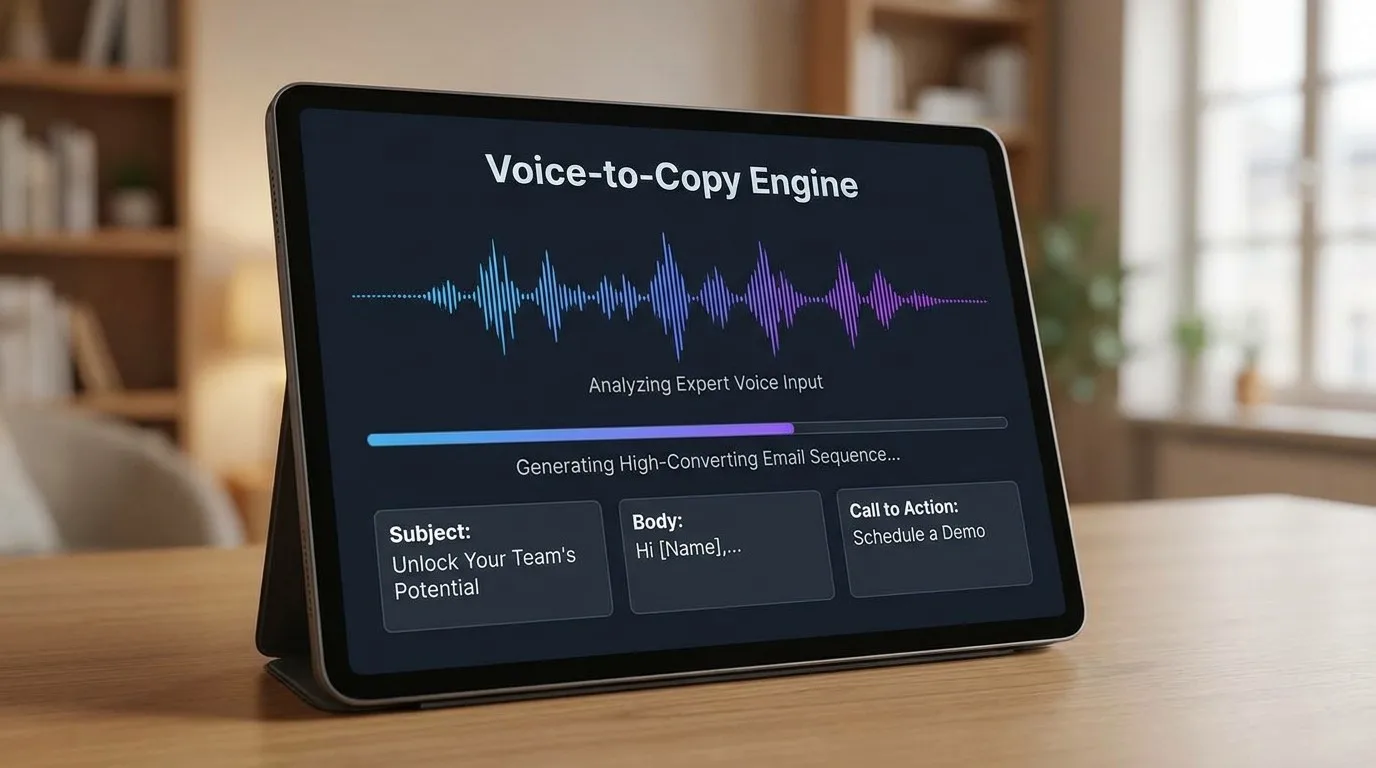
According to OpenAI’s official documentation, the Whisper model is currently the gold standard for capturing technical jargon and accented speech.
How to Feed the AI Your Slang, Rhythm, and Jargon
The secret to cloning tone of voice is the injection of Brand DNA.
You must provide the model with a curated list of idiosyncrasies.
If you call your students “Monsters” instead of “Clients”, the AI welcome email sequence must reflect that.
This rhythm is what makes copywriting for high-ticket offers work.
3. Technical Blueprint: Automating the Transcript-to-Copy Pipeline
To run this system at scale, you can automate the entire workflow using a Python architecture hosted on an unmanaged server or via automation tools like n8n.
The system takes a raw transcript file, injects your unique brand voice constraints, and handles the entire content processing lifecycle automatically.
The code block below provides a production-ready template to deploy this exact voice processing engine:
import os
from anthropic import Anthropic

def run_voice_to_copy_engine(raw_transcript_path: str, brand_voice_dna_path: str, output_channel: str) -> str:
    """
    Executes Stage 4 of the Voice-to-Copy Pipeline.
    Processes unedited transcription data through Anthropic Claude,
    applying strict brand voice profiles to generate high-converting copy.
    """
    # Initialize the Anthropic client securely
    client = Anthropic(api_key=os.environ.get("ANTHROPIC_API_KEY"))

    # Read the raw transcript data
    with open(raw_transcript_path, 'r', encoding='utf-8') as f:
        transcript_content = f.read()

    # Read your permanent Brand Voice DNA profile
    with open(brand_voice_dna_path, 'r', encoding='utf-8') as f:
        voice_dna = f.read()

    # Define the core operational directive for the model
    system_instruction = (
        "You are an advanced, high-EQ content extraction engine. Your objective is to take a raw, "
        "unedited voice transcript and transform it into a refined, high-converting marketing asset. "
        "You must protect the author's natural speech patterns, unique insights, and personality markers, "
        "while stripping away verbal fillers and redundant loops."
    )

    # Structure the engineering prompt with clear context blocks
    prompt = f"""
    TASK: Transform the provided raw transcript into a structured, high-converting {output_channel}.

    PERMANENT BRAND VOICE DNA CONSTRAINTS:
    \"\"\"
    {voice_dna}
    \"\"\"

    RAW UNEDITED TRANSCRIPT DATA:
    \"\"\"
    {transcript_content}
    \"\"\"

    STRICT EDITING DIRECTIVES:
    1. Do not use generic marketing buzzwords (e.g., 'delve', 'testament', 'revolutionize', 'masterclass').
    2. Maintain the exact technical sophistication and domain specific concepts present in the transcript.
    3. Ensure the text flows naturally, utilizing varied sentence lengths and clear structural breaks.
    4. Start directly with the core message. Do not add introductory greetings or conversational meta-text.

    Generate the finalized product below:
    """

    # Execute the processing model
    response = client.messages.create(
        model="claude-3-5-sonnet-20241022",
        max_tokens=3000,
        system=system_instruction,
        messages=[
            {"role": "user", "content": prompt}
        ],
        temperature=0.35 # Balanced to allow natural tone variation while keeping focus tight
    )

    return response.content[0].text
4. The Production-Ready Transcript Transformation Prompt
If you are running this workflow manually, you need an engineering prompt that forces the AI model to respect the raw conversational data while applying clean conversion structures.
The prompt below is optimized to act as an advanced stylistic engine within Anthropic’s Claude:
USER COMMAND:
You are an expert copywriter with an advanced understanding of linguistic analysis and emotional quotient (EQ) modeling. Your task is to process the raw, unedited voice transcription provided below and transform it into a polished, high-converting marketing asset, specifically formatted as a [INSERT TARGET ASSET TYPE, E.G., DAILY EMAIL / SALES PAGE MODULE].

CORE STRATEGIC MANDATES:
1. CAPTURE THE LINGUISTIC DNA: Identify the speaker's specific jargon, preferred analogies, and unique way of structuring arguments. Keep these elements completely intact. Do not homogenize the text into a standard marketing template.
2. SYSTEMATIC FILLER REMOVAL: Cleanly excise all conversational loops, repeated thoughts, and standard speech fillers (such as 'like,' 'um,' 'basically,' 'you know what I mean') without shrinking the depth of the core argument.
3. FLUFF-STRIPPING COMPLIANCE: If the transcript contains casual, simple phrasing, keep it simple. Never translate direct, plain-spoken language into generic corporate buzzwords like 'unlocking success' or 'leveraging synergy.'
4. CADENCE AND FLOW DIRECTION: Organize the final text using varied sentence lengths and clean, bite-sized paragraph structures. The opening line must drop the reader straight into the core technical insight or story without greeting filler.

RAW EXPERT TRANSCRIPTION DATA:
[INSERT YOUR UNEDITED TRANSCRIPTION TEXT HERE]

PERMANENT TONE PROFILE ATTRIBUTES:
[INSERT A BRIEF LIST OF YOUR SPECIFIC SPEECH ATTRIBUTES, PHRASES YOU USE, AND CORE PERSPECTIVES]

OUTPUT FORMAT:
Provide the finalized, production-ready text asset. Do not include introductory notes, conceptual explanations, or conversational confirmation commentary.
The Tone-of-Voice Reverse Engineering Prompt (Step-by-Step)
To truly master how to clone tone of voice with AI, you must use reverse copy optimization.
First, provide 3-5 audio transcripts.
Second, ask the AI agents to extract the syntax patterns.
Third, save this as your Tone Profile.
This is how you create a weekly newsletter with AI that doesn’t sound like a bot.
5. Comparative Evaluation: Raw Audio vs. Structured Conversion Output
To understand how the system extracts high-value marketing arguments from informal speech, review the processing simulation below modeled after high-ticket infoproduct offers.
The Raw Voice Input Transcript (messy Data): “So… I was thinking about how people launch their courses, right? And everyone is doing these huge webinars and it’s honestly just killing them. Like, I talked to this mentor yesterday, a really smart guy, and he spent like four thousand bucks on Facebook ads to get people onto a live Zoom call. And then what happened? His power went out midway through, the link broke, and his cart conversion completely tanked. It was a total mess. And I told him… look, why are you doing this? You should just put your core mechanism into a simple 3-minute video sequence, host it on a clean server, and drive your traffic straight there instead of trying to put on a massive live show every single time. It’s way more reliable and doesn’t break.”
The AI-Engineered Voice-to-Copy Output (Boring Copy Framework): “Yesterday, an established mentor told me he spent $4,000 on Facebook traffic to drive registration to a live webinar launch. Midway through his live presentation, his local power network failed, the checkout link glitched, and his final conversion rate dropped to zero.
This is a structural risk that can be completely avoided. Trying to run live launches introduces too many technical variables that you cannot control.
The solution is to remove the live element entirely. Take your core mechanism, package it into a high-density, 3-minute recorded video sequence, and host it directly on a dedicated, stable server. This automated asset handles the presentation for you perfectly every time, eliminating technical vulnerabilities and converting traffic reliably without requiring your active presence.”
Why this Workflow Succeeds: The engine completely eliminated the conversational filler while preserving the real-world story, the hard financial metrics ($4,000, 3-minute video), and the pragmatic perspective of the expert.
The final copy reads with absolute authority, completely avoiding any artificial marketing cliches.
Maintaining Digital Integrity While Scaling Content Production
Scaling shouldn’t mean diluting.
By using AI to create and sell micro-infoproducts, you can maintain Digital Integrity.
Every AI pre-launch CPL script you generate should feel like a 1-on-1 conversation.
This is the gold standard of the American expert economy in 2026.

6. Generative Engine Optimization (GEO): Securing Placement in Conversational Search Indices
Maximizing your content’s reach requires ensuring your voice-driven assets are optimized for Generative Engine Optimization (GEO).
AI discovery systems like Perplexity, SearchGPT, and Claude regularly scan the web for unique, experiential content to reference in their conversational answers.
- AI Scraper Workflow: Scrapes Web -> Ignores Generic Copy -> Extracts Experiential Case Data -> Cites Brand
Technical Strategies for GEO Content Architecture
To ensure conversational AI discovery engines regularly feature and cite your voice-captured articles, implement these core data strategies:
Verifiable Experiential Formatting: AI search tools favor real-world case data and direct technical experience. When your articles are built from real voice notes detailing actual client situations and real numbers, the text naturally contains specific data points that AI engines look for.
Structured Concept Integration: Organize your unique business insights using clear HTML5 semantic headers and clean definition blocks. If your audio introduces a specific operational concept, ensure that term is clearly defined right away in a bold structural block.
Learn more about how to optimize your site for AI chatbots.
7. Deep Long-Tail GEO Frequently Asked Questions
How does the Voice-to-Copy engine prevent AI models from hallucinating technical details? To ensure absolute accuracy, you must restrict the model’s operation using clear boundary constraints in your system prompts. Instruct the AI core to look only at the facts, metrics, and technical frameworks explicitly stated within the provided transcript file. By blocking the model from pulling information from its external training data, you eliminate the risk of hallucination.
Can I train an open-source LLM on my server to automate this voice processing pipeline securely? Yes. You can host an open-source model like Llama 3 on an unmanaged server or virtual private server (VPS). Running your transcription and processing pipelines entirely on your own local infrastructure allows you to maintain total ownership of your internal data.
What formatting styles should my processed copy use to ensure it is easily read and indexed by AI search crawlers? AI search crawlers are optimized to parse high-density informational structures. Organize your processed copy using clean Markdown formatting, descriptive headings, and concise paragraphs that start directly with core facts. Presenting technical definitions or case steps within structured tables allows scrapers to quickly recommend your content.
Ready to capture your Irreplicable Authenticity?
Stop let your best insights disappear into WhatsApp history. Start building your Brand DNA today.
Join the Voice-to-Copy Revolution
Turn your natural expertise into high-converting sales assets with the click of a button.
Get Started for FreeInstant access to BVM Context Calibration Engine · No CC required
Frequently Asked Questions
How does structured brand context support voice to copy method ai transcription? Structured brand context provides persistent memory for audience traits, core offer mechanisms, and voice guidelines, reducing off-brand drafting.
Can teams update their positioning while keeping previous copy assets? Yes. Systematic versioning allows teams to evolve brand parameters while maintaining auditability for past campaign iterations.
What is the primary operational metric improved by this approach? Teams typically measure success by reduced editorial revision loops and consistent message match across discovery and conversion channels.
Ready to Transform Your Copy Operations?
Transform Your Copy Operations
Build a persistent Brand DNA memory that eliminates prompt degradation across all channels.
No credit card required · Instant access to Brand DNA Engine